Thursday, October 2, 2014

Erasmus, The Praise of Folly; More, Utopia

Though I feel as if I got a lot out of the medieval philosophers––the Islamic theologians and Maimonides especially––I did complain quite a bit about the dense logic they often employed, lines of reasoning that were mystifying on first (and usually second) read. Indeed, one of the most unique aspects of scholasticism, as far as I’m concerned, is a glorification of Aristotelian logic. How, then, does the Renaissance set itself apart as a separate epoch?

At the same time that Europe experienced a rebirth of classical scholarship, it experienced also the rise of humanism, which was no longer concerned with the monastic approach to arguments that so dominated the previous era. Renaissance humanism instead, as Clarence Miller writes in his introduction to Erasmus, “might be simplistically described as an attempt to regain and restore the rightful roles of grammar and rhetoric.” Simplistic as that may be, it’s an excellent working definition, as we’ve already seen the way Boccaccio and Chaucer brought language and rhetoric to the fore. So too do the figures of today’s post, Desiderius Erasmus and Sir Thomas More.

The two men were friends and often made references to one another in their works, which have much in common. The Praise of Folly and Utopia both make constant reference to the Greeks and Romans. Both are written in Latin. And perhaps most significantly, both join in rhetorical games that stretch the boundaries of logic. In Folly, an encomium (or work of praise) to Folly written by Folly herself, we hear praises and defenses of foolishness so strong that it is difficult to untangle what Erasmus believes from what is tongue-in-cheek. In Utopia, a narration about a perfect society living on an island, our confidence in the so-called perfection of the community is constantly undermined by the narrator, and we are left unsure of what to make of this place called Utopia.

Such is the power of rhetoric, as demonstrated by two of the most famous Renaissance humanists. In today’s post, we’ll consider these two works, which recall and reinforce one another so strongly, and ask what the often paradoxical and disarming rhetoric employed by these two great writers can tell us.


Folly

There is plenty to be discussed in the Praise of Folly as far as arguments go, but even more interesting than its content is its structure. First, Praise is an encomium, that is, a speech written in praise of someone who is generally worthy of such a speech. The most famous example is probably the “Encomium of Helen” by the ancient sophist Gorgias, who gave many reasons for why Helen should be praised, despite having a pivotal role in the start of the Trojan War. So generally, encomia are written by one person in praise of another. Not so with Erasmus’ work, which is written ostensibly by Folly about Folly herself. Who else, it seems to imply, would wish to write a hymn of praise to someone as decidedly unpraiseworthy as Folly?

Folly sets out to prove that she is indeed praiseworthy, and does so in a three-act structure, here described by Clarence Miller:

“(1) Folly provides the illusions necessary to render life in this world tolerable or even pleasant… (2) Folly makes the professional leaders of church and state blind enough to be happy in their vicious irresponsibility… (3) Folly enables the Christian fool to renounce the world in favor of Christian joy in this life and the beatific vision in the next.”

Folly begins in act one (note that these acts are interpolated by scholars and don’t represent hard divisions in the text itself) by describing the ways in which she makes life bearable for the average person. She follows this by extending her duties to leaders of church of state, allowing them to be happy despite the terrible job they do. She concludes by saying that she also helps the Christian fool endure the irresponsibility of the very leaders whom she has made subject to her power.

Immediately we see a problem in this so-called three-act structure. The sections are related to one another, but they also seem to be responsible for one another. All men are foolish in order to live with the absurdities of life; included among all men are leaders of church and state; yet Christians, also included among all men, are miserable without folly exactly because of the leaders of church and state. I wanted to be fancy and say that the middle section acts as something of a chiasma, but on second thought, I don’t think that’s accurate. The entire work, in fact, is rather reminiscent of Homer Simpson’s dictum about alcohol: Folly is the cause of, and solution to, all of life’s problems. Or even more accurately, it is like this SMBC

Of course, Folly is very convincing if you don’t think too hard about her arguments. She begins by describing the plight of all men: that their wisdom runs counter to their passions:

“Moreover, he [Jupiter] limited reason to the narrow confines of the head, leaving all the rest of the body to passion… How much reason can do against the forces of these two [anger and passionate desire] is sufficiently clear from the everyday life of mankind: she does all she can, which amounts to no more than shouting herself hoarse and preaching moral rules, but the passions tell their ruler to go to the devil and shout her down all the more impudently, until she is so tired that she gives in and knuckles under.”

Who has not experienced such a dilemma: did not Augustine rail against this very problem in his Confessions? The mind is no match for the will, and it is even difficult, truly nearly impossible, to bend one’s will to one’s will; Godel would prove this about half a millennium later.

Folly’s arguments in fact remind me very much of a certain episode I experienced. Once, some friends and I were watching American History X. If you are unfamiliar with the movie, Edward Norton stars as an neo-Nazi who returns from prison seeing the error of his ways and seeks to keep his younger brother from going down the same path. There’s a scene early on when Norton, before his stint in prison, confronts his mother’s new lover, a Jewish man, about the atrocities perpetrated by the Jews and how they are the cause of the world’s woes. Yet Norton is not your run-of-the-mill bigot, but a brilliant rhetorician, and he chooses his examples and his words and his tone so carefully that even my friend, watching the film with me, asked, Is it racist if I agree with him? The answer, despite what you may think, is no: Norton, the character, was written so that he would be convincing. Think of Ivan Karamazov, how he could not free himself from his own arguments. Norton is a racist, but he’s also smart, and there’s nothing wrong with falling for his arguments prima facie. But it is upon closer inspection that his arguments, as well as Folly’s, are shown to hold no water.

Take for example the direction she goes after the opening pages. She gives examples (we see how much Erasmus loves the Classical age here) from Circero and Quintillian: Cicero, she says, praises trepidation, Quintillian, fear. Therefore, she says, don’t they “clearly admit that wisdom is a hindrance to doing a job properly?” She continues:

“The fool plunges into the thick of things, staring danger in the face, and in this way (unless I am badly mistaken) he acquires true prudence. Homer seems to have seen this (in spite of his blindness) when he said ‘a fool is wise after the event.’”

Who has not had this same thought? Has not much been made of people like the subway hero in New York, and parodied on 30 Rock? Hell it was even written about in that book All Things Shining by a couple really important philosophers. But it’s said by Folly, so we must see the problem with the argument. Just because apparent vices like fear and trepidation are praised does not mean that wisdom should be discarded, cast aside as a relic of a former time. Rather, wisdom can be found separating true folly from wise folly: a fool is wise after the event, but only to those who saw his wisdom as foolishness. Time does not separate the fool from the wiseman; rather, judgment does.

But let us not spend all our time picking apart Folly’s arguments. It is enough that we know that her words are not to be taken at face value.

Having disposed with normal people, Folly moves on to leaders of church and state. First up, the medieval theologians:

“Certainly, though no one is less willing than they are to recognize my good will toward them, still these men are also obliged to me for benefits of no little importance. They are so blessed by their Selflove as to be fully persuaded that they themselves dwell in the third heaven, looking down from high above on all other mortals as if they were earth-creeping vermin almost worthy of their pity… In all of these there is so much erudition, so much difficulty, that I think the apostles themselves would need to be inspired by a different spirit if they were forced to match wits on such points with this new breed of theologians.”

Truly, this is an argument that could not have been made a few hundred years ago. Folly criticizes the scholastics for turning the teachings of the apostles into a series of increasingly complex word games, so that even the saints themselves would not be holy by the definition of these philosophers.

Yet we should notice something else about this second section: the language is very different. There are fewer rhetorical flourishes, fewer direct references to Folly herself. Rather, this middle section seems as if it could have been written by Erasmus without any reference to a goddess. If any of Folly’s words can be put into Erasmus’ mouth, they would certainly be from this section. This is supported by a comment made by William H Gass in his wonderful afterword: “Erasmus wanted the church to allow the study of pagan authors because he often found them wise and in every way as virtuous as the accepted saints.” Perhaps Erasmus recognized the wisdom of the pagans as well as the folly of many of the saints who, virtuous though they may be, are still foolish.

Finally, Folly quotes the prophets whom she said would find no support from the theologians, quoting them as proof that even God recognizes the importance of her work.

“But [the prophet] Jeremiah professes this belief much more frankly in his tenth chapter: ‘Every man,’ he says, ‘is rendered foolish by his wisdom.’ Wisdom he attributes to God alone, leaving folly as the lot of all men.”

But that’s clearly not what he’s saying. Wisdom is indeed God’s, but that does not mean man receives no share of it: recall that men are made in the image of God, and that a great deal of scholarship in the past centuries was dedicated the showing how wisdom is God’s gift to men. This is true too of the other passages he quotes, such this passage, either from Ecclesiastes or Ecclesiasticus: “A fool changes like the moon, a wise man is immutable like the sun.”


Utopia

The difficulties of Folly lie in its structure and its arguments. More’s Utopia engages with the same rhetorical challenges as Erasmus’ work, but it also derives confusion from its use of language. This problem is brought to light in its very title: Utopia, which in modern parlance is synonymous with “good place” (eu-topos in Greek), can also be translated as “no place” (ou-topos). To skirt middle-school-English analysis, neither is the “correct” translation: the point, rather, is that the Utopian island is both a good place (if we are to believe the narrator Hythloday, which we perhaps shouldn’t, as his name translates to “peddler of nonsense”) and a place that can’t possibly exist, which we will discuss in a moment. The reality of Utopia seems predicated in fact on its hanging in the balance between these two interpretations. The critic Edward Surtz, as quoted in the introduction, writes:

“Is the Utopian view of war, religion, and communism really absurd? Is the Utopian vision really hopeless and unachievable? Utopia therefore is an open-ended work––or better a dialogue with an indeterminate close. More asks the right questions––which can never be answered fully.”

I would change the words just a little: because More asks the right questions, we can never know for certain. For if such a place that fulfilled all of More’s hopes could exist, it already would; since it doesn’t, it cannot.

Why can Utopia not exist? One possible reason: money. Hythloday describes Utopia as having a wealth of gold, but not recognizing that wealth as such. That is, the citizens of Utopia know about the evils of money and therefore do not use it, though it has so much that it could utilize. A lovely idea, is it not? But how would its citizens, who have presumably never left the island, how would they know of the havoc money has wrought on other countries? One might answer, from the books that are brought to the island, works by Plato and Aristotle. Yet they would then know that money is worthwhile elsewhere and would leave the island, taking some of it along with them. It is simply a fanciful dream that such a place could exist. As Jerry Harp writes in the afterword, “You can’t get there from here.” Utopia is a “no place” because it is internally inconsistent; there is no way for such a place to exist.

Moreover, Utopia doesn’t really seem like a great place. Its solutions all seem too elegant and don’t account for the tempestuous nature of human psychology. Take their clothing: “when they go out in public they put on cloaks which cover these rough clothes; throughout the island they are all of the same color…” It seems that Utopians are free from vanity as well as greed. Or take children: “For it is not possible to set a limit for children. This limit is easily maintained by transferring persons from households with too many people to those with too few.” This could never work, for reasons that don’t need to be discussed.

And this is the other point I want to make about the book. Utopia is a simple place. Hythloday, in describing it, uses simple language. Everything is black and white. The sentences are short, the syntax straightforward. In his rhetoric, we may think he has accounted for everything. And, just as Edward Norton may have tricked some of us into becoming neo-Nazis, so Hythloday tricks us with his language.

When criticizing England, on the other hand, Hythloday’s language is anything but simple. In fact, in two places, he uses a sentence that lasts more than one page, straining, as Clarence Miller writes in the introduction, straining the Latin syntax almost to its breaking point. Who but the (post-)modernists would construct such a sentence? What practical need is there for language like that? Yet that is exactly what Hythloday employs, that which is unnecessary, in service of his goal. As much as he admires the Utopians, it seems that even he cannot live up to their unrealistic standard.


Stray Observations
  • Folly: “I always look exactly like what I am.” Not I always am what I am, but the appearance of such.
  • Folly: “Just as nothing is more foolish than misplaced wisdom, so too, nothing is more imprudent than perverse prudence. And surely it is perverse not to adapt yourself to the prevailing circumstances, to refuse ‘to do as the Romans do,’ to ignore the party-goer’s maxim, ‘take a drink or take your leave,’ to insist that the play should not be a play. True prudence, on the other hand, recognizes human limitations and does not strive to leap beyond them; it is willing to run with the herd, to overlook faults tolerantly or to share them in a friendly spirit. But, they say, that is exactly what we mean by folly. I will hardly deny it––as long as they will reciprocate by admitting that this is exactly what it means to perform the play of life.”
  • Folly: “Nowadays flattery is thought of as disreputable, but only by people who are more concerned about words than about things themselves… Not to mention that this flattery plays a large part in that eloquence everyone praises, a larger in medicine, and the largest of all in poetry ––in sum, it is the honey and spice of all human intercourse… But to be deceived, they say, is miserable. Quite the contrary––not to be deceived is most miserable of all. For nothing could be further from the truth than the notion that man’s happiness resides in things as they actually are. It depends on opinions.”
  • Folly: “Surely you don’t believe that there is any difference between those who sit in Plato’s cave gazing in wonder at the images and likenesses of various things––as long as they desire nothing more and are no less pleased––and the wiseman who left the cave and sees things as they really are?”
  • A portion of a sonnet by George Santayana, as quoted by William H Gass in his afterword: “It is not wisdom to be only wise / and on the inward vision close the eyes / but it is wisdom to believe the heart as well.”

Monday, September 8, 2014

Chaucer, The Canterbury Tales

Like the Decameron of his predecessor Boccaccio, Chaucer’s Canterbury Tales is a set of stories organized around a framing device. Instead of taking shelter from a rampaging plague, Chaucer’s theme is more light-hearted: a group of travelers tell stories on their way to Canterbury and back, and whoever tells the best story wins. Yet unlike Boccaccio’s rigidly structured stories, which deliver on their initial promise of a hundred, all evidence indicates that Chaucer never planned to finish his tales; that he set out to create an unfinished work. Complicating the matter further, Chaucer also died while writing the tales, meaning the work is unfinished not just by design, but by accident.

To speak then of an overall theme to the stories may not be the correct way of approaching Chaucer’s work. Rather, the stories contain what scholars term centers of meaning, concerns so important to such a number of tales that they become fundamental to the meaning of the collection as a whole. Gender is such a theme: Chaucer, to a far greater extent than Boccaccio, is sympathetic to the plight of women and writes stories that showcase not only the intelligence and dignity of women, but also their suffering. This is not the same suffering as in Boccaccio when a woman is stripped naked and left for dead on top of a tower. Rather, Chaucer shows the suffering of everyday women and shows how such suffering should earn the greatest praise in a Christian society. As Christopher Cannon says in the introduction:

“If suffering is taken to be a positive good (if, like Christ, Christians are most virtuous when they can endure great hardship), then the medieval ideal of marriage (in which the wife must endure whatever demands her husband makes on her) makes women especially good in Christian terms. If there is a power imbalance in these religious tales, in other words, it is actually all in favour of women: to precisely the extent that the men in these tales cause women to suffer, they are actually helping them to be better Christians than those men could ever be.”

Rather than justifying women’s oppression, “Chaucer is simply bringing together two fundamental truths for a Christian society and emphasizing their inherent connection.”

Another sphere of meaning is the power of language, as exemplified by the famous nun’s priest’s tale about Chanticleer and Pertelote. To Chaucer, language amounts to action, and we can see this in the way Chanticleer escapes the fox’s mouth by making him talk. The act of convincing is another important theme in Chaucer.

This is going to be a shit post because that’s all I got for Chaucer. I don’t know what else to say about the guy, which is odd considering I really enjoyed the tales in high school. Now, though, they were pretty uninteresting. I'm unsure if this post would have benefited from my having read the tales in the original middle English rather than in translation. I felt that the distance between Chaucer and modern English is a vaster expanse than, say, Shakespeare and modern English, if because of nothing but nonstandard spelling. I’ll mention a few quotes I enjoyed, and simply hope for a better post next time on Erasmus and Thomas More. Sorry.


Stray Observations

“Love is a mightier law, upon my soul, than any made by any mortal rule; For love, all man-made laws are broken by folk of all kinds, all day and every day. A man is bound to love, against all reason.” Oh hey, doesn't this sound like Brothers K?

“We don’t know what we pray for here below, but, like a man drunk as a wheelbarrow, who knows he’s got a home where he can go, but doesn’t know which is the right road thither –– for when you’re drunk, then every road’s a slither, yes, in this world, that’s how it goes with us; all frantically seeking happiness…”

“People aren’t always on their best behaviour as fire is––for fire is always fire.” Great line.

A lament about the rocks that may kill her husband as his ship returns home: “ ‘Eternal Lord! Thou who foreknowest all, and guidest thus the world with sure control, thou makest nothing, so men say, in vain. But lord these rocks, so hostile, black, and grim, which rather seem the work of a foul chaos than any creation of a God so perfect…why has Thou created so irrational a work, which neither south, north, west, nor east benefits either man or bird or beast.”

Friday, August 15, 2014

Boccaccio, The Decameron

“I do not doubt for a moment that you believe what you say to be true. But as far as I can judge, you have not devoted much attention to the study of human nature. For if you had, you surely possess enough intelligence to have discovered certain things that would cause you to think twice before making such confident assertions. When the rest of us spoke so freely… we were merely facing facts.”

Once again, it has been too long. Another busy couple months went by, during which I read a bit of William of Ockham and Umberto Eco’s The Name of the Rose, along with one or two other things, and I didn’t manage to find the time to update. I had planned, was even in my own strange way looking forward to writing a dual post about Ockham and Eco, since the latter’s book is a medieval detective story featuring a Holmesian monk who cut his teeth on Ockham. And Ockham himself had a lot of interesting ideas that I would have liked to have thought more deeply about. Unfortunately, as time went by, I couldn’t bring myself to make sense of the notes I had taken; Ockham’s thought is difficult, and though it pains me to admit I just can’t sit down and read logic for very long. So Ockham and his razor have been shelved for now, until a time when I can revisit him.

Instead, we get the fortuitous opportunity to follow a post about Dante with a post about another Italian writer, Boccaccio, who was deeply influenced by the great poet. In the years since he wrote, he and Dante have gained a complementary relationship. Whereas Dante wrote The Divine Comedy, Boccaccio’s magnum opus, whose official name is the Decameron, has been called the “human comedy.” Although we will return to Dante’s influence, I want to focus now on the “human” aspect of this comparison, because we notice that above all else Boccaccio is concerned with the human.

Granted, in the past we have talked about the human––after all, there isn’t that much else to write about if we are writing about people––but never have we seen humanness take center stage in such a frank way. If Dante writing the greatest epic poem of all time in vernacular allowed his descendents––including Boccaccio––to cast off the shackles of Latin and write for a wider audience, then Boccaccio writing about mankind allowed for everyday human life to become the center of the literary universe in a way that became the status quo.

Truly, the lives of everyday men and women were not written about until this. (Definitely not women, who play lead roles in many of Boccaccio’s tales.) I learned in a course on Shakespeare that stories were once reserved for adventurers, warriors, explorers: those who had a story to tell, so to speak. Yet by gathering together ten men and women seeking shelter from the bubonic plague, Boccaccio proved that everyone (even women) have things to say that entertain not only themselves, but all people.

I put such an emphasis on women because Boccaccio claimed that the Decameron was written to women and for women, so that they who were unable to voice their concerns and laments could see that those laments and those concerns were universal and thereby lighten their unbearable heaviness. Boccaccio does not deny the lovesickness and hardships of men––he recounts that he had also been “inflamed beyond measure with a most lofty and noble love”––but that women, having to hide their love (which is “far more potent than one which is worn on the sleeve”), having to spend “most of their time cooped up within the narrow confines of their rooms,” having to sit “in apparent idleness…reflecting on various matters,” women have a much more difficult time with their burdens. And so he writes to such women, who due to decorum would never reveal their true desires.

I say “such women” because all women were not created equal to Boccaccio. For all his claims of taking pity on “people in distress,” some of his stories (not all by any means, but a portion) are terribly misogynistic. At this point, we must do our due diligence by acknowledging that we as enlightened, 21st-century people should not condemn people of the past or bind them by our standards of living. Even still, for all Boccaccio’s talk about writing for women, there are many stories of women being tormented at the hands of men. Aside from “tragedies” wherein the mistreatment of the woman is not directed at women in general, there are stories where a man’s triumph over a woman is glorified in a rather disturbing way. I’ll leave it to those more qualified than me to decide what to make of such stories, but it’s good to keep in mind as we’re reading that Boccaccio carries this worldview. Chaucer, as we’ll see in the next post, is much more sympathetic toward women, in word as well as deed. But I’m getting ahead of myself.

To confess, I did not read all of the hundred stories of the Decameron. There are only so many stories about late medieval life that I can handle, and that number ended up being around fifty or so. In thinking about how to structure this post, I decided to concentrate on a few stories that I found particularly interesting or enlightening, and go over the others only briefly.


Love, Intelligence, Fortune

Dante, as we have said, used the Commedia as a way of summing up all that came before him. In Boccaccio, we occasionally see references to the old stuff: a Greek name here or there, a biblical character recast. But the absolute most striking feature is Boccaccio’s unabashed modernness. His prologue, the very first we read of his writing, immediately mentions three qualities: gratitude, pity, and love; love is the greatest cause of distress; pity is taken on those in distress; gratitude, the result of pity, is, in his words, the virtue most worthy of commendation. Apart from love, these are not the usual virtues we’ve encountered, especially in our recent slew of Christian texts (and Boccaccio’s love is not exactly Christian love either). Sure, gratitude and pity are aspects of greater virtues, but they themselves are not primary.

The three principal themes of the Decameron, according to my translator, are love, intelligence, and fortune; since there is little mention of God (only mention of the depravity of His creation), we must conclude that the love and intelligence are not divine, but human. It is the love between men and women, between kin, between friends, between enemies even that is glorified. Auerbach wrote that “the Decameron develops a distinct, thoroughly practical and secular ethical code rooted in the right to love.” The narrators, the ten hiding from the plague, have been taken to represent the drama of the human soul, which pits “the rational appetite against the lower irascible and concupiscible appetites… the intellectual power of reason [against] the baser human emotions of anger and lust.” That intellectual power runs the gamut between the new ethical code that Auerbach indicates and “strategems adopted by wives and the religious to achieve the gratification of their sexual desires.”

Of the three, only fortune is still distinctly inhuman, but even it is less a god or supernatural being than a force of nature. As intelligent as his characters often are, they still see themselves as subjects of fortune, and do not appear to have the uniquely Machiavellian insight that fortune can be tamed by forethought and intelligence.

Aside from this, Boccaccio’s modernness is manifest throughout the work. Some stories, for example, get their tragic conclusion by way of “blind and unthinking adherence to an outmoded concept of honour.” Rather than having things work out because of virtue, virtue, especially a rigid conception of such, is a hindrance in Boccaccio’s world.

Which, granted, is not hard to imagine. It’s a time when people are running around trying to escape the plague. And as I read (I forget if it’s Boccaccio’s own words or the translator’s introduction), the plague acted in a way as natural selection. For example, women had female attendants who were, among other things, allowed to see them nude for things like dressing. But due to the plague, many of these attendants were dead or else just didn’t want to touch these plague-stricken old broads. So the women who wanted to survive would often ask male attendants to wash them or attend to their sores. As such, Boccaccio (I think) implies that the women who made it out of the plague were distinctly less concerned with decorum than those who died. Not exactly scientific, but an interesting argument nonetheless. Think of it as survival of the sluttiest. (Sorry.)


Tancredi and Ghismonda; Guillaume and His Wife

Of course Boccaccio’s masterwork wouldn’t be a masterwork if there were simply a hundred stories that were only loosely connected by a framing device. Ten people telling ten stories each is relatively uninteresting by itself, and so there should be some sort of internal structure lurking below like a shark beneath the waves.

Indeed, there is such a structure, and if I had read more closely, I likely would have discovered more than just the two examples I have below. But let’s not dwell on my shortcomings and instead focus on the stories that complement each other so well.

One occurs in day four, the first story, wherein Prince Tancredi discovers that his daughter has been sleeping with a man of whom he has not approved, and he takes the reasonable action of killing the young man and sending his daughter the man’s heart in a chalice, at which point the daughter becomes distraught and poisons herself and dies. Before the heart incident, however, Tancredi to his credit lets his daughter know that he is aware of her transgression and asks her to stop. What follows is rather unprecedented: his daughter, the unfortunately-named Ghismonda, delivers a long speech to her father declaring that she has done nothing wrong, that she has acted of her own volition and chosen someone whom she considers worthy of her, and that she, as an individual should be allowed to make such choices. The entire speech is rather abrupt, especially for the time: who would give a woman such a long speech? In fact, Boccaccio says in the first story of day six, “it is more unseemly for a woman to make long speeches than it is for a man.”

Are we to take him at his word here? That would be difficult since Ghismonda’s speech is so perfectly reasoned as to make her father seem like a backwards, oafish moron. In fact, it reminded me quite a bit of Nora’s speech from Ibsen’s A Doll’s House both in its veracity and in its utter incongruence with the rest of the story. I would conclude that it is not unseemly to Boccaccio for a woman to make such a speech; rather, Boccaccio is demonstrating his more enlightened opinion of women, namely that they are capable of deep and original thinking, and that they should be taken seriously; all this taking place more than 600 years ago.

Anyway, in spite of or perhaps due to Ghismonda’s tenacity, her father kills her lover and his brutishness causes her to kill herself. Her father realizes the error of his ways far too late, and mourns her death.

In the ninth story of the same day, Guillaume finds out that his unnamed wife has been sleeping with another man, coincidentally also named Guillaume. He kills this pseudo-Guillaume and feeds his heart to his unnamed wife, who, upon finding out what she has done, throws herself off of a casement sans speech, whereupon the living Guillaume sees the error of his ways and repents.

What do we make of these parallel stories? There are subtle differences. Tancredi suffers a speech from Ghismonda, who commits suicide despite not having ingested the heart of her lover as Guillaume’s wife did. Both women reach their end because of the lover’s death rather than the abject horror of cannibalism.

But let’s not speculate whether Guillaume’s wife would have killed herself had she only seen and not eaten the heart of Guillaume-Part-Two. Instead, we can notice that Ghismonda speaks her mind, yet comes to no better conclusion than Guillaume’s wife who does not get to plead her case. (Hell, she doesn’t even have a name.) The guy writing the introduction to my edition stresses that for all Boccaccio’s progressive tendency, he still carries a great deal of anti-feminist and misogynistic baggage. Which granted, yes he does. But I would argue that these parallel stories are something of a lamentation. In saying that it is unseemly of women to make long speeches, Boccaccio is lamenting the lack of voice women have; that a brute like Tancredi can act so violently even in the harsh light of reason; that for all their erudition and intelligence, women are subject to the whims of men––or more broadly, fortune––regardless. Or at least that’s what I gather.


Mithridanes and Nathan; Gisippus and Titus

In day ten, there is another pair of complementary stories. In the third story, a generous man named Mithridanes is envious of an even more generous man, Nathan, and decides to kill Nathan so that he can be the most generous man alive. Nathan, being of almost Christlike generosity, says that men have been killing other men all throughout history and is happy to see that Mithridanes is motivated not by hatred, “but in order to be better thought of,” a motivation Nathan considers noble. Nathan then speaks of how commonplace killing is, and that, despite being on the receiving end of Mithridanes’ murderous rage, there is “nothing marvelous or novel” about it. In the end, Mithridanes does not kill Nathan, cannot kill him, and the two end up being friends.

There is something wonderfully subversive about this story, as if Nathan were some amalgam of Christ’s simple compassion, John Galt’s overwritten, objectivist dispassion, and McCarthy’s Judge Holden’s apassion; can you not hear the ringing tones of “War is God” in Nathan’s serene meditation on murder?

In the eighth story of the same day, Gisippus is pledged to marry Sophronia. His friend, Titus, however, has meanwhile fallen so in love with Sophronia that he cannot imagine being with another and is constantly tormented by his thoughts of her. Titus confesses this to Gisippus who, instead of being outraged by his friend's treachery, says “The laws of Love are more powerful than any others; they even supplant divine laws, let alone those of friendship.” He then offers Titus Sophronia’s hand, though not telling her about this arrangement at all. Of course this backfires and the story runs for a while, eventually turning out positively for both men. Sophronia, despite being tricked into sex with and marriage to another man ends up pretty alright as well, all things considered.

The similarity between these two stories is the elevation of vice to divine principle. Nathan opines that murder is a fact of the world, and that he should feel honored that he is being murdered out of a desire to be better rather than something more hateful like power or wealth. Similarly, Gissipus finds that Titus is subject to some universal force the maw of which he cannot escape. As such, he is sympathetic to his friend and offers him exactly what he desires, regardless of the difficulties such an act inevitably present to him. In both stories, there is praise of sin and kowtowing to new world-principles. Boccaccio sees the power of love and wrath in the world; no doubt since he writes so many stories about sex and violence. Yet rather than condemning them categorically as evils, he sees gray areas, times when such transgressions should be praised. This transcends the otherwise acceptable nature of his humanism, or at least the nature that is acceptable to us in our time. Sin is not black and white to Boccaccio. There is some indication of means being justified by ends, or even those means not being all that mean to begin with. (Jokes.)


Joseph and Melissus

Finally, I want to mention my favorite story. The ninth story of the ninth day involves Melissus meeting a man named Joseph while both are on their way to consult with the biblical ruler Solomon about what to do with their respective predicaments; Joseph has a stubborn wife, and Melissus seeks to be loved by his fellow man (no homo). Solomon is terse with both men: he tells Melissus to “love”, and Joseph to “go to Goosebridge.”

At Goosebridge, the two men see a farmer beating the crap out of his stubborn mule, telling the men that sometimes stubbornness answers only to wrath. Inspired, Joseph returns home and violently beats his wife until she becomes submissive to him. Literally, that is what he takes away from the encounter at Goosebridge. This scene occurs in front of Melissus, and it is described in great, often repulsive detail. I say great detail mostly in comparison to Melissus’ part of the story; after watching his companion beat his wife half to death for a full page or two, Melissus simply returns home and tells a wise man what Solomon said, and the wise man tells him that it is true, that one must love others to be loved in return. At which point the story says that Melissus was loved from then on, and concludes. Josephus gets pages for his domestic violence, and Melissus gets literally a paragraph, and a short one at that.

The obvious point to make here is that Solomon gives opposite pieces of advice to the men: though they both desire something from other people, Solomon advises one to love (that is, be generous in some way toward others) and the other to berate (to withhold pity and kindness); the opposing pieces of advice both produce the desired effects. The advice to Joseph to beat his wife takes a little bit of convincing, however: when they arrive at Goosebridge and the muleteer beats his mule, the men are taken aback at the man's savagery. Yet when it produces results, they cannot object. Perhaps Boccaccio is advocating something akin to sparing-the-rod.

What perplexes me more, though, is the brevity with which he treats the advice given to Melissus. Whereas Joseph needs to be convinced firsthand, Melissus needs only short words of encouragement to understand the importance of love. Love, then, may come more naturally in Boccaccio’s mind than hate. Whereas love is our natural tendency and requires only a nudge in the right direction, we must be convinced that wrath and discipline are occasionally necessary. (This goes back to our earlier point that vice can occasionally be elevated to virtue.) Forgetting for the moment that domestic violence is terrible, we should remember the difficulty and roundabout-ness it took for Joseph to be convinced to beat his wife: first, he is not told to be wrathful, but rather to go to a certain place. At that place, he fortuitously encounters this man. It took the power of chance (that Solomon in his wisdom could somehow control), of fortune, to convince Joseph of the right course of action. The words of a stranger, even one as exalted as Solomon, would not have been enough.


Stray Observations

  • The Decameron is similar in structure to the Arabian nights: “the spectre of imminent death is held at a manageable distance” by the telling of stories; here it is the spectre of the plague.
  • The translator: "[When Boccaccio says] the power of Love is greater than your power or mine [he] seems intent upon showing its validity. Not only that, he implies that any attempt to interfere with the natural progression of instinctive forces is doomed to failure.”
  • Of wicked clergy: “They had applied the name of ‘procuration’ to their unconcealed simony, and that of ‘sustentation’ to their gluttony, as if… God were ignorant of the inventions of their wicked minds and would allow Himself to be deceived, as men are, by the mere names of things.” Man, if I had paid more attention to Ockham, he probably would’ve had a lot to say about that.
  • “There is a certain proverb, frequently to be heard on the lips of the people, to the effect that a dupe will outwit his deceiver – a saying which would seem impossible to prove but for the fact that it is borne out by actual cases.”
  • In story one of day five, a dullard, Cimon, acquires wisdom after he falls in love with Iphigenia. Recall in Gilgamesh when the wild man Enkidu is tamed by sex.


Sunday, June 1, 2014

Dante, The Divine Comedy

When James Joyce wrote Ulysses, he had no doubts about the greatness of the work he had produced. In one of his characteristically self-aware quotes, he claimed that he had overstuffed the novel with so many puzzles and allusions that academics would spend years deciphering them, thus ensuring his lasting fame. This may seem a big middle finger to readers who enjoy books for, you know, pleasure, but he did it with a purpose. Joyce saw himself as part of a line of artists regarded as the greatest not only of their generation but of their entire epoch. He believed that he was the artistic successor of Shakespeare, who in turn had succeeded the subject of today’s post, Dante.

But what made Dante so great, and why did Joyce believe that it took nearly 300 years for someone to eclipse him? Joyce, the canonical Modernist, was a destroyer, an undoer, one who took established structures and tore them down; in doing so, he heralded a new era of literature, in which one was free to create and experiment in a way previously impossible. Dante, Joyce’s antipode, was, rather, as Eugenio Montale writes in his introduction, “summing up... bringing his era to a close.” In its myriad references to Christian theology and Greek and Roman mythology, Dante’s Commedia gathered together all that came before it, closing out the Classical world and the Middle Ages.

But just as Joyce destroyed in order to open the floodgates, Dante did not just close an era: he created a new one. By writing in Italian, a relatively unsophisticated language compared to Latin, he asserted the power of other languages and their place in literature, allowing writers like Boccaccio and Petrarch to flourish later on.

His Commedia bears more than just this resemblance to Joyce’s Ulysses. Just as Leopold Bloom, the analogue of the powerful Odysseus, had not the deeds to live up to his namesake, Dante––as protagonist of the Commedia––is no epic hero, and the poem itself no Aeneid, despite the presence of its creator, Virgil, guiding Dante through the afterlife. The Commedia, though certainly qualifying as an epic poem by its length, leaves much to be desired in terms of action and heroism. Throughout its hundred cantos, our hero does not prove his worth through battles against demons, no matter how many video games think he did. Dante uses his journey to purify and prepare himself for heaven. He is not the hero that we root for, but a lost traveler, one who is found in the midst of his own sin and despair. A silent protector, a dark knight, a… shit, wrong post.


Limbo

I don't actually want to talk about limbo in Dante; rather I just have a comment that I didn't know where else to place.

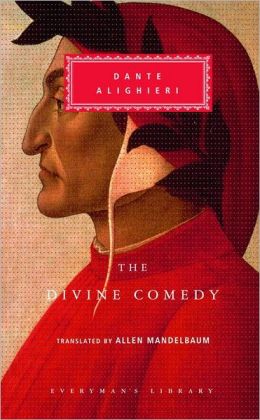
For my library, I chose the Allen Mandelbaum translation of Dante, from Everyman Library. I've heard that every translator wants to try his hand at Dante, but I never heard why that is. It makes sense, though, because there are tons of translations out there, at least half a dozen of which would be fantastic to read. Of the ones I was choosing from, there were ones by Robert Pinsky, former poet laureate; Burton Raffel, noted scholar and translator of Don Quixote; Mark Musa, who's translated other prominent Italian works, including Bocaccio and Petrarch; Robert and Jane Hollander; even Henry Wadsworth Longfellow. Point being, any one of these translators probably would've done a fantastic job, but I chose Mandelbaum, who translated my version of Ovid's Metamorphoses as well and which I thought was done very well.

As with other comments about translations, I should say again that I don't know any Italian. My choice of translation is based on a few things: the prominence of the translator (because I'm a fame-whore), the publisher, and any excerpts I could find. Based on all those criteria, and the fact that I wanted to read the entire Commedia, I chose Mandelbaum.

Inferno

“In the middle of my days, I shall go to the gates of Hell…” – Isaiah

Dante begins his journey in the year 1300, the year he turns 35, which is “midway through life’s journey,” according to the biblical conception of 70 as the perfect age. He is confronted in a dark wood by vicious animals representing the cardinal sins that plague him, and he is saved by Virgil, who informs him that it is his job to lead Dante through the afterlife so that he can see what awaits him and hopefully turn back to the "path that does not stray." He does so at the behest of Beatrice, the object of Dante’s unrequited love, who has recently died.

As Dante is led first to the gates of hell by Virgil, he notices the inscription upon them, which ends with the famous line, “Abandon all hope, ye who enter here.” This is a grim inscription, no doubt: those who lie in hell have no hope, presumably of ever again being happy or even just not being painfully tortured. Yet Dante has a very specific notion of what constitutes hope, a notion that is only fully revealed by reading the entire Commedia. In Paradiso, he defines it: “Hope is the certain expectation of future glory.”

It is important to read the levels of the afterlife through Dante’s idea of hope. When he encounters the souls in purgatory, they are much less miserable than the ones in hell, not because their tortures are less painful (they might be, but they are tortures nonetheless) but because they have hope. The hope they have is distinct from the way we might conceive of hope as something that may or may not come to be: Dante’s hope, the hope of the souls in purgatory is the certain knowledge of the existence of God and the certain expectation that they will be exalted. The shades in hell have this knowledge, but without the accompanying expectation. Their future is the same as their present, and so it will always be. As Virgil says, “Those who are here can place no hope in death, / and their blind life is so abject that they / are envious of every other fate.”

Before discussing any further, I want to point out something else about hell’s gate: it’s wide. It’s wide enough to receive all manner of souls who fell short of God’s glory. In an article I read (from, uh, somewhere long forgotten) about why people choose to read Inferno and Purgatorio over Paradiso, the author agrees with a sentiment I’ve held: goodness is too plain. The gate to heaven, as the Bible says, is “strait and narrow,” in that there are few ways to enter it. Just as Tolstoy notes at the start of Anna Karenina, “Happy families are alike in happiness.” There are few ways to be happy, fewer still to be good; yet there are plenty of ways to be evil, and plenty of ways to suffer.

The next distinction between hell and purgatory is a sensible distinction. Hell is palpable, hell is sensate, hell is as real as the world above. Throughout his journey, Dante talks about his inability to keep his footing on the rocks that make up hell’s floor; he hears the anguished cries of the shades: “Here, for as much as hearing could discover, / there was no outcry louder than the sighs / that caused the everlasting air to tremble.” This is another difference that makes hell that much worse for the damned. Unlike the souls of purgatory, who recognize some difference between their world and the human one (for example, they are not bodies, but souls), the shades of hell can make no such distinction.

And who are the shades? Lots of Italians, for one thing. In fact, as Dante journeys deeper into the underworld, exploring deadlier and deadlier sins, the number of Italians he encounters seems to grow. He certainly had beefs with lots of Italians. Pope John XXII was a huge dick to him, exiling him and sending him away from his beloved Beatrice, whom we meet in Paradiso. I’ll admit that, apart from reading a little on his background with John 22 and the Guelphs, I mostly skipped over the long digressions into Italian politics because, I mean, come on. If there’s one takeaway from this, though, it’s that Dante, like Luther after him, really hates greedy clergymen.

There are more famous people in hell, too, but just as importantly, there are some famous people not in hell: for example, Virgil, Dante’s guide, and Aristotle, the “master of those who know.” They earn a spot in limbo, where they “have no hope, yet [they] must live in longing.” For all his piety, Dante cannot bring himself to believe that God would damn these two great men.  Montale notices this, too: “The apparent injustice of God’s exclusion of good non-Christians from Paradise clearly worried Dante.” Limbo also reflects Dante’s admiration of Thomas Aquinas: those who reside there followed what St. Thomas would call natural law: living as well as pagans can, as closely to divine law as human reason can determine. (Speaking of which, there is a castle in hell: the castle of human reason. Pretty funny, I think.)

Dante’s mission to hell would seem too light if it were only a journey, a kind of “scared straight” (or strait?) program ordained by God. As such, he is not only a casual observer. Rather, he is a participant, to a slightly reduced degree, in the torture and suffering of hell. Throughout the poem, Dante suffers as the souls and shades do: in Purgatory, for example, when he is among the slothful, Dante begins to feel too lazy to climb the mountain further. Dante, everyman that he is, suffers from the whole spectrum of human follies, and it is through his journey (recall that he “lost the path that does not stray”) that he receives an expedited cleansing.

Of course the characteristic feature of hell is the idea of symbolic retribution: the punishment fits the crime, so to speak. And for every obvious copy we’ve seen of Dante (for example, the glutton in the film Seven who is forced to eat until his stomach explodes), Dante himself is usually pretty clever. Take the Epicureans, who, we recall, denied the existence of an afterlife. Rather than simply being punished, they are entombed in coffins for eternity; even having died, they are not finished dying. Like, shit dude. For another example, Cerberus, the three-headed dog of Greek mythology, is guardian of the gluttonous, because he, like they seem to, has three mouths for eating.

We can’t move on to purgatory without encountering the final boss of the inferno: the devil. In Dante, hell has a conical structure: as one progresses further down, the circles become tighter and tighter, as if the architecture were rarefying our expectation, focusing it on some pinpoint of grand evil that is to be revealed in the final canto. Yet, in a brilliant subversion of our expectations, Dante makes the devil the poorest figure in hell. More impotent than the ferryman even, Satan sits half-frozen in ice, far as he is from the warming love of God, and in his mouth, he eternally chews––but cannot consume––those sinners who betrayed their masters: Judas, Brutus, and Cassius. He is described later in Paradiso as being “held in constraint by all of the world’s weights” as if he were the ultimate subject of the world, rather than a infiltratory figure.

In the time since Dante, some of the power of this portrait of the devil has been lost, but we need only remember the way the devil is characterized in essentially all other media: a powerful, malevolent being; even in satirical characterizations, like the prince suffering under the abusive rod (pun intended) of Saddam Hussein in South Park, he is still lord of his domain, reigning with an iron fist. In Dante, however, he is the ultimate sinner, the one who suffers more than any other being.

His presence is even impotent: he appears for but a moment. In the span of a single canto, Dante and Virgil meet him and quickly vault over him like a pile of garbage, and exit hell, ending up back on the surface of the earth, albeit in the barren, unpopulated southern hemisphere. Apparently, the belief back then was that the southern hemisphere was the ancient location of the garden of Eden and that, since the Fall, it has been covered in oceans and thus unfit for human settlement. The only thing that stands out in the landscape is the mountain of purgatory, at the peak of which sits the Garden of Eden, the holiest place on earth. Where they came up with this is unclear to me, since the Bible describes Eden as sitting at the intersection of the Tigris and Euphrates rivers, which is in Iraq.


Purgatorio

At any rate, they arrive at purgatory, where sinners are subjected to cleansing labors which, as we discussed, differ from the punishments of hell mostly in that they have the hope––that certain expectation––that they will soon enter heaven.

Speaking of hope, Virgil tells Dante that, contrary to the church’s teachings, no one is so far gone from the love of God that they can’t be saved: “Despite the Church’s curse, there is no one / so lost that the eternal love cannot / return––as long as hope shows something green.” God’s love is boundless, so much so that anyone can find it. Dante reflects on the mystery of such salvation: “Foolish is he who hopes our intellect / can reach the end of that unending road… / Confine yourselves, o humans, to the quia [Latin for the facts themselves, not the reasons why]; / had you been able to see all, there would / have been no need for Mary to give birth.” Again, this my reflect Dante's belief that a just God could not truly punish men as great his the philosophers and poets he admires.

Before Dante’s time, purgatory was seen as a place of literal fire, where sins were burned off. Dante sees it as an active process rather than a passive punishment. You earned your place in heaven. The people in purgatory also suffer symbolic retribution: the prideful, for example, are forced to carry heavy stones so that their eyes are turned to the ground, humbled: “They were indeed bent down–-some less, some more–- / according to the weights their backs now bore; / and even he whose aspect showed most patience, / in tears, appeared to say: ‘I can no more.’” This agonized cry of futility is even more heartbreaking than the tortures hell. Yet we are not to despair, for as Virgil reminds Dante: “Don’t dwell upon the form of punishment: / consider what comes after that.”

Dante, though, cannot help but be moved to love, and cares about those who suffer here in the afterlife. In doing so, he notices that love is both the cause of all good things and all evils as well. He asks Virgil what love, then, is. Virgil responds that love is the propensity of our soul to “respond to everything that pleases.” “It’s nature / that joins the soul in you, anew, through beauty… / Then, just as flames ascend because the form / of fire was fashioned to fly upward, toward / the stuff of its own sphere, where it lasts longest, / so does the soul, when seized, move into longing, / a motion of the spirit, never resting / till the beloved thing has made it joyous.” Good thing that “there is in you, inborn, / the power that counsels, keeper of the threshold / of your assent: this is the principle / on which your merit may be judged, for it / garners and winnows good and evil longings. / Those reasoners who reached the roots of things / learned of this inborn freedom; the bequest that, thus, they left unto the world is ethics.” Free will, then, is the ability to limit love in all its forms.

As they climb, they finally reach the summit of the mountain of purgatory, where they encounter Beatrice, who, since Virgil is a heathen and cannot enter the kingdom of Heaven, will lead Dante the rest of the way. Dante is understandably thrilled to see her once again: “Within her presence, I had once been used / to feeling–trembling–wonder, dissolution; / but that was long ago. Still, through my soul, / now she was veiled, could not see her directly, / by way of hidden force that she could move, / I felt the mighty power of old love.” And again: “I am left with less / than one drop of my blood that does not tremble: / I recognize the signs of the old flame.”

She, in an interesting turn of events, is less than thrilled to see him. Since her death, he has turned, in her mind, away from the strait and narrow, and for this, she scolds him. She treats him like a mother would a "raving child," emphasizing not only the love of God, but His role as a father, and therefore Beatrice’s analogous role as a mother. Mothers love, but must also instruct.


Paradiso

As I said earlier, Paradiso is usually considered the least interesting part of the Commedia: Inferno is the imaginative one, Purgatorio is the poetic one, and Paradiso is the one where Dante keeps talking about how things are too beautiful to describe. Yet there is much to get from his account of heaven.

Take for instance the structure of heaven. As hell as circles and purgatory has levels, heaven has spheres, yet these spheres are not distinct. If they were, then some souls would be further from God’s love than others, and this is patently false. Rather, just as there are different choirs of angels which, unlike Dogma says, do not resent one another for being at different levels but commune together in God’s glory, so too do people belonging to different spheres feel the same amount of God’s love. It is only due to Dante’s humanity that he cannot comprehend heaven if it appeared in any other form.

Even still, Dante has trouble comprehending heaven, more than he had trouble comprehending hell and purgatory. So Beatrice begins to guide Dante. As Virgil did, Beatrice points things out to him, but rather than simply explaining the logic behind what’s going on as Virgil did, Beatrice must in a way justify certain decisions of God’s, as His will is often inscrutable to Dante as a human. She explains, for example, the Fall. The Fall was, in a way, inevitable, despite the order with which we are created: 

“Yet it is true that, even as a shape / may, often, not accord with art’s intent, / since matter may be unresponsive, deaf, / so, from this course, the creature strays at times / because he has the power, once impelled, / to swerve elsewhere; as lightning from a cloud / is seen to fall, so does the first impulse, / when man has been diverted by false pleasure, / turn him toward earth. You should–if I am right– / not feel more marvel at your climbing than / you would were you considering a stream / that from a mountain’s height falls to its base. / It would be cause for wonder in you if, / no longer hindered, you remained below, / as if, on a earth, a living flame stood still.”

As they pass through the different spheres, Dante must pass several “tests” to see whether he truly believes and understands God well enough to be in his presence. These tests involve asking him what different aspects of Christianity are. For example, he is asked what faith is, to which he replies: “Faith is the substance of the things we hope for / and is the evidence of things not seen.” As we said before, faith is evidence. Apart from this being an interesting philosophical concept in itself, Dante further believes that the faith of the world is even greater proof of the truth of Christianity. “I said: ‘If without miracles the world / was turned to Christianity, that is / so great a miracle that all the rest / are not its hundredth part: for you were poor / and hungry when you found the field and sowed / the good plant–once a vine and now a thorn.’” In much the same way that Dostoevsky believed that yearning for God was proof of God, Dante believes that the reality of a worldwide belief in Christianity (not completely worldwide, but perhaps it had a greater spread than other religions at the time) was definitive proof of the truth of Christianity.

Again, we notice that we’re not really spending much time on the actual encounter with God. This is partly because Dante spends so much of his time getting ready, as if the entire Commedia were the antechamber to God’s domain, and partly because Dante lacks the words to describe God. “How incomplete is speech,” he laments, “how weak, when set / against my thought!” I’ll close with the final lines of the poem:

“As the geometer intently seeks / to square the circle, but he cannot reach, / through thought on thought, the principle he needs, / so I searched that strange sight: I wished to see / the way in which our human effigy / suited the circle and found place in it–– / and my own wings were far too weak for that. / But then my mind was struck by light that flashed / and, with this light, received what it had asked. / Here force failed my high fantasy; but my / desire and will were moved already––like / a wheel revolving uniformly––by / the Love that moves the sun and the other stars.”


Stray Observations

  • Montale in his introduction gives a lot of his own opinions about Dante’s relation to our modern, scientific world. He sees Dante as a “distant precursor” of Romanticism, the movement that is “dissatisfied with its own rationalist, enlightened age” and looks to the Classical world for inspiration. Moreover, he sees our new, scientific age not as the “modern era” but as a “new Middle Ages whose characteristics we cannot yet make out.”
  • “And just as he who, with exhausted breath, / having escaped from sea to shore, turns back / to watch the dangerous waters he has quit, / so did my spirit, still a fugitive, / turn back to look intently at the pass / that never has let any man survive.”
  • Everyone who is dead, especially those who recently died, beg Dante to tell their stories to the outside world. It’s really strange, although I guess not in the context of the poem. Even the people who were terrible, they all want someone to tell their story, for their name to live on.
  • Minos, the “connoisseur of sin”, judges the newly dead and assigns them to a level of hell. Just like the sorting hat!
  • Lots of women in the circle of lust…ladies.
  • “There is no greater sorrow / than thinking back upon a happy time / in misery…”
  • Divination is a sin because it implies that we can figure out God’s plan; ascribing passivity to God is a big no-no.
  • Ulysses in Dante sounds a lot like the Ulysses of Tennyson: “Neither my fondness for my son nor pity / for my old father nor the love I owed / Penelope, which would have gladdened her, / was able to defeat in me the longing / I had to gain experience of the world / and of the vices and the worth of men.” More: “Consider well the seed that gave you birth: / you were not made to live your lives as brutes, / but to be followers of worth and knowledge.”
  • “Haste denies all acts their dignity.”
  • “The man in whom thought thrusts ahead of thought / allows the goal he’s set to move far off-–the force of one thought saps the other’s force.”
  • “Enter; but I warn you–-he / who would look back, returns–-again–-outside.” Then: “When I had crossed the threshold of the gate / that–-since the souls’ aberrant love would make / the crooked way seem straight–-is seldom used, / I heard the gate resound and, hearing, knew / that it had shut; and if I’d turned toward it, how could my fault have found a fit excuse?”
  • “Why are you driven back by wind so slight?”
  • “I felt incomparable joy, / so that I lifted up my daring face / and cried to God: ‘Now I fear you no more!’–- / as did the blackbird after brief fair weather.”
  • “And like the rapid change that one can see / in a pale woman’s face when it has freed / itself from bearing bashful modesty…”
  • Beatrice is “the lady who imparadises / my mind.” Never seen that word before. Damn.

Sunday, April 20, 2014

St. Thomas Aquinas, Selections from the Summa Theologica

The past three months have been a blur. Though I enjoy having a job---or rather, though I enjoy the perks that come with having a job, such as free time and disposable income---the regularity makes it easy to lose track of time; hours become days, days become weeks, and soon enough, you haven’t updated your blog since St. Anselm. But it’s not only my job that’s kept my blog stagnant. After the archbishop of Canterbury, I decided to read David Foster Wallace’s Infinite Jest, an undertaking that took about six weeks. I vacillated between writing and not writing a post about it; I certainly had enough thoughts about the book to do so, though I didn’t take many notes. (It’s hard enough to carry that book places, I couldn’t be bothered to bring a pen, too.) After that, I had a couple non-starters: the Poetic Edda and Rumi both presented difficulties, mostly due to my unfamiliarity with the cultures they came from.

When I came back to my reading list, I was confronted with St. Thomas Aquinas, whom I had been excited to read because he’s a big deal in Christian theology and because he was so important to Dante (whom we will discuss next time) and Joyce (whom we will discuss in a couple decades when I reach the early twentieth century). Unfortunately, I didn’t take very good notes on Aquinas, and I will explain why with the following series of excuses.

First, the Summa Theologica, the subject of today’s blog post, is, for lack of a better word, a beast. Aquinas’ project is in a totally different ballpark than, say, Anselm’s, which only sought to prove the existence of God. Aquinas, on the other hand, gives five separate proofs of the existence of God, and that happens within the first hundred pages of the couple-thousand-page Summa (of which, I read about 400 pages). The fact is that the Summa was intended to be, as the name suggests, a summation of the whole of Catholic theology. And unlike our colloquial use of “summation,” Aquinas meant that he was going to explicitly derive every major belief in Christianity from either the Bible or the works of past philosophers and theologians. So it’s a doozy.

Secondly, the Summa is dry. I’m not just talking textbook-prose dry. Every single section of the Summa follows the same format: it begins with a question and several (incorrect) answers to that question; then, there is a statement to the contrary, which usually comes from, like I said before, the Bible or another philosopher; then, Thomas asserts his position based on that statement; finally, he responds to each of the erroneous answers in light of the true answer. This style makes his points incredibly clear, though incredibly dull.

Finally, the Summa is cumulative. Many answers depend upon and make use of previous answers. Often, individual questions are specific to the point of being mysterious: why would Thomas ask such a strange question? The answer to that is always, Because he’s going to use it later. This is a criticism I've heard about math textbooks as well, where certain results are proven without any motivation only so that they can be used later on in a larger, more obviously important proof.

Because of all these excuses (and more!), this will be a fairly short blog post, and structured a little bit differently. In that it will have no structure. Ahem.

Despite all my bitching, one must be in awe of the Summa and also of Thomas. (It seems that people usually refer to him by his first name rather than his last, so in order to seem cool, I will, too.) Just imagine: the Summa consists of some 100-odd questions in its two parts; each question is made up of articles, usually between five and 10; each article contains some erroneous arguments that must be refuted, usually two or three. That gives us between 1,000 and 3,000 arguments that he alone collected, considered, and refuted, with evidence. This, more than anything that we’ve come across so far (except maybe Plotinus’ Enneads), is worthy of being called a magnum opus.

Aside from revolutionizing Catholic philosophy, why is Thomas important? As the editor of my edition, Anton Pegis, writes, Thomas’ philosophy marked “the first decisive encounter between Hellenism and Christianity.” But John, you’ll say, haven’t there been lots of encounters between Greek philosophy and Christianity? Isn’t that what you’ve been telling us, you asshole? Yes, it is, but I'm not wrong (probably). Other religions, specifically Judaism and Islam, have had fruitful encounters with the Greeks; and Christianity has, as well, with Augustine’s encounters with neo-Platonism. But it isn’t until Thomas that Greek philosophy is truly used.

Here’s what I mean. While Augustine found a structure for his thoughts in neo-Platonism, Thomas was in dialogue with Plato and Aristotle. To him, Plato came as close to truth as could possibly be reached by a pagan; that is, by someone with no access to divine revelation. Plato’s problem, Thomas argues, is that he reached conclusions about being by thinking, by using his reason, which is a part of his being. This method fails, as Pegis writes, “by as much as the human reason or human abstract thought is powerless, by itself, to apprehend and to know the conditions of actually existing things. For, according to St. Thomas, there are many and profoundly important aspects of existence that thought alone or the reason alone cannot know about things.” So not only has Aquinas evaluated the merits of Plato's philosophy, he has criticized his methods for being insufficient.

Where does Aristotle come in? Traces of the Philosopher (as Thomas reverently refers to him) are everywhere in the Summa: the argument for the existence of God based on the existence of a “prime mover;” the refutations that depend as much upon the Aristotelian corpus as they do upon the Bible; the very structure of the Summa as a logical, cohesive catechism all borrow from Aristotle. In fact, one might say that Thomas is not simply the first decisive encounter between Hellenism and Christianity, but between Aristotelianism and Christianity.

But he doesn’t only converse with Aristotle and Plato. The influence of the Islamic philosophers, particularly Averroes, is evident as well. Consider his argument that “it was necessary for the salvation of man that certain truths which exceed human reason should be made known to him by divine revelation.” This sounds like something we’d hear from the Islamic philosophers, who emphasized the power of revelation to supplement human reason. Moreover, he writes, “the mode of knowledge follows the mode of the nature of the knower.” Recall both the Islamic philosophers and Maimonides, who stressed that not all truths can be and should be revealed to all people; to each person is revealed what he is capable of knowing.

The most important thing I personally discovered in terms of Thomas’ philosophy is his belief in natural law. This is something that we haven’t really seen yet. Maimonides mentioned that the law given to the Israelites was not the end-all-be-all law, but merely a transitional law that is closer, but not equivalent to the true divine law. But Thomas’ natural law is different. Essentially, natural law is a set of moral and ethical principles that can be derived by human reason. Without reference to any god or gods, one can unequivocally say that killing another person is wrong. This law is ultimately related to the divine prohibition against murder since all human reason comes from God, but it can be conceived of without divine revelation.

That’s pretty much it. I assure you that the next post on Dante will be much more comprehensive. I’ve already transcribed my notes, and damn, there are a lot of them.


Stray Observations

  • Food for thought from Pegis: “We are bound to say that the European man became a thinker after [Thomas and also after] he ruined himself as a knower; and we can now even trace the steps of that ruination–from Augustinian Platonism to the nominalistic isolationism of Ockham to the despairing and desperate methodism of Descartes. For what we call the decline of mediaeval philosophy was really a transition from man as a knower to man as a thinker.”
  • Thomas also does the thing a lot where he says, “Such and such abstract concept has n distinct forms” and goes on to list those forms (a) as if this mysterious number of forms is exhaustive and (b) as if he’s a living Buzzfeed article or something.
  • He proves that there is not "greatest evil" because, simply, there cannot be two first principles. It's like a proof of uniqueness following several proofs of existence.
  • Habits are active powers that, through repetition, overtake passive powers that were previously in place, and become the new passive powers. Makes sense. Also, sounds like Aristotle.